
Building Through the Lines: How Langston Park Is Rewriting History in Sylvan Hills
February 17, 2026
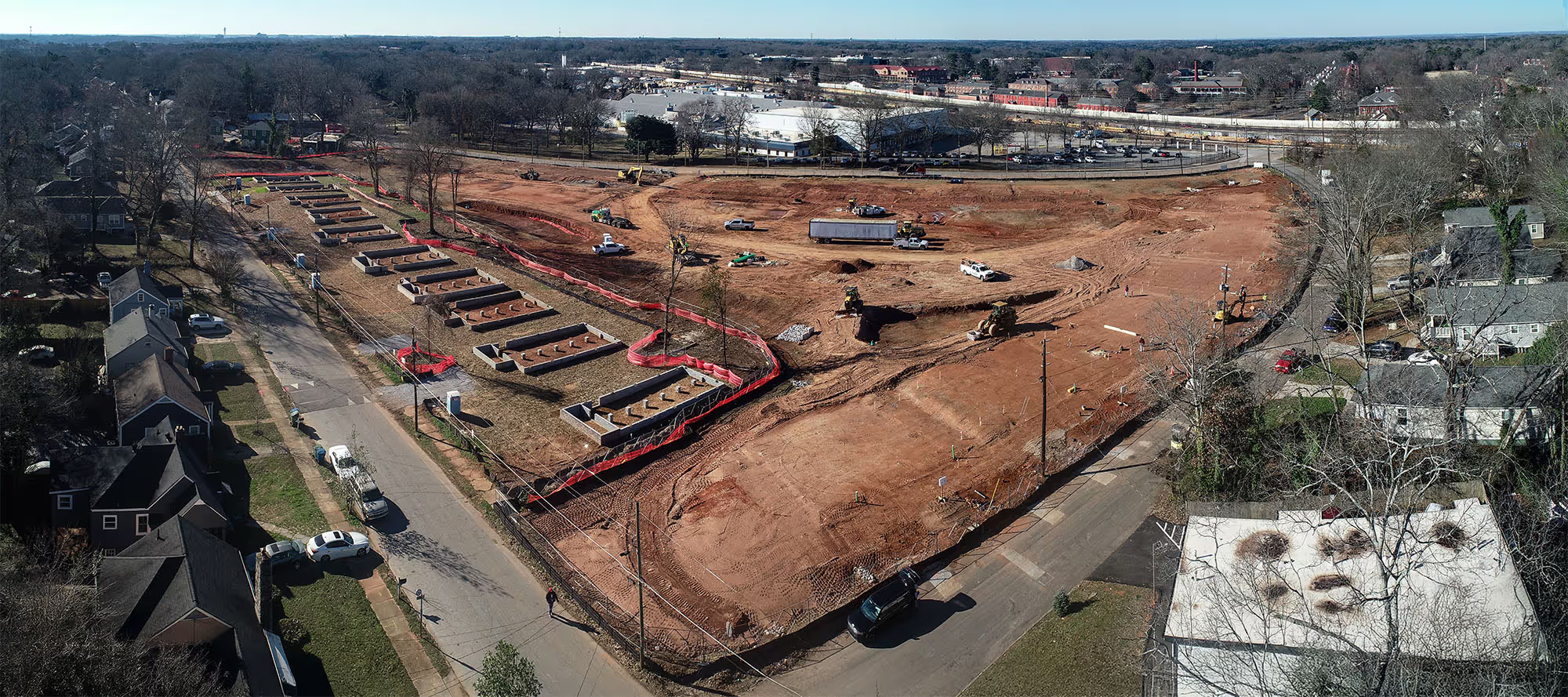
Sylvan Hills has always been a neighborhood with a story. One that Atlanta can’t tell without also telling the truth about who was invited in… and who was shut out.
Decades ago, parts of Southwest Atlanta were shaped by the same forces that shaped so many American cities: redlining maps, biased lending practices, and neighborhood rules that drew hard racial lines around opportunity.
And Sylvan Hills carries receipts.
Historic records and neighborhood documentation show that Sylvan Hills was once marketed and restricted as a whites-only subdivision. This was part of the broader pattern of exclusion that kept Black Atlantans from buying into stable neighborhoods and the generational wealth that often comes with homeownership. Even when families did everything “right,” the system still tilted the playing field by denying loans, depressing property values, and steering investment elsewhere. That’s not ancient history. That’s the blueprint Atlanta inherited.
So when you stand in Sylvan Hills today and look at the construction of Langston Park, you’re not just looking at the foundation of new homes.
You’re looking at a neighborhood rewriting its own story.
A neighborhood reversing the math of exclusion
Langston Park is being built inside a place that was once designed to keep people out. That’s what makes it history-making in a way you can feel in your chest.
Atlanta Habitat for Humanity has described Langston Park as a bold step forward for affordable homeownership in Sylvan Hills—bringing modern, sustainable, townhome-style living in a way that’s new for Atlanta Habitat’s history. This matters because it flips the script on what these streets used to symbolize.
Redlining wasn’t just about where people could live. It was about where people could thrive. Where families could build equity. Where kids could inherit something. Where communities could count on investment.
Langston Park tells a different Atlanta story: one where inclusive development doesn’t happen around historic neighborhoods, it happens within them, on purpose, with intention, and with a clear message: The future belongs here, too.
24 homes in one week: a city-speed act of repair
Then there’s the sheer scale of what’s about to happen.
From May 3–8, 2026, the Jimmy & Rosalynn Carter Work Project will return to Atlanta, and Atlanta Habitat will bring volunteers and partners together to build 24 homes in just five days as a major kickoff for Langston Park. Twenty-four homes. In one week.
In a city where housing challenges can feel massive and slow-moving, this is a different kind of statement for Atlanta Habitat. And one we will continue to make going forward: We can build faster and larger when we build together.
That’s history-making not just because it’s rare, but because it’s public. Visible. Communal. Thousands of hands showing up with hammers and hard hats to do the kind of work that redlining prevented, creating stable homeownership opportunities at scale.
If redlining was a coordinated system of denial, this build is a coordinated act of yes.
Yes to families.
Yes to stability.
Yes to a neighborhood that deserves investment without displacement.
Yes to the idea that affordable homeownership can be modern, beautiful, and right where people want, and need, to live.
The ripple effect: a measurable change in homeownership
And the impact isn’t just symbolic, it’s measurable.
By the time Langston Park is fully complete, Atlanta Habitat projects that homeownership in the Langston Park area will increase by about 10%.
A 10% increase means more families with a stake in the neighborhood. More residents who can build equity instead of watching rent climb out of reach. More kids growing up with the stability that research and real life both connect to better outcomes, school consistency, health, opportunity and peace.
And in a neighborhood once shaped by who couldn’t buy, that increase becomes its own kind of victory.
Why this moment is bigger than new buildings
Langston Park isn’t history-making only because it’s a development.
It’s history-making because it lands right at the intersection of Atlanta’s past and Atlanta’s potential:
- A neighborhood that once enforced exclusion is becoming home to an intentionally inclusive community.
- A city that has wrestled with segregation and disinvestment is hosting a global project focused on affordable homeownership and building 24 homes in five days, in public, together.
- A place once shaped by denial is now being shaped by neighbors, volunteers, partners, and future homeowners choosing a different legacy.
This is what it looks like when a city doesn’t just preserve history, but learns from it.
Not by pretending the old lines never existed, but by building right through them.
Join the Cause
Help expand access to affordable homeownership by contributing your time, talent, or resources.

Donate
Contribute financially to help uplift individuals and families through affordable homeownership.

Volunteer
Join the volunteer Construction, ReStore, or Family Services teams and turn our mission into action.

ReStore
Shop or donate unique home goods and building materials at our stores to support our mission.